Modern fab plants rely on tightly controlled vacuum environments across multiple process steps such as PVD, CVD, ALD or other deposition techniques, in order to produce uniform, high-purity films. RGAs are routinely used to provide visibility into what gas species are present in the chamber at any given time, helping catch contaminants before they impact the process.
Before deposition: leak checking and vacuum quality
RGAs can be used for leak checking and vacuum quality monitoring prior to the start of deposition. Air leaks, internal or virtual leaks and trace contaminants at very low levels can all degrade film quality and must be detected before a process is initiated. An RGA can quickly tell you what you are dealing with and help verify when a chamber is truly ready for deposition to begin. The procedure for tracking down each type of leak is covered in more detail under UHV and leak detection.
During deposition: sampling at process pressure
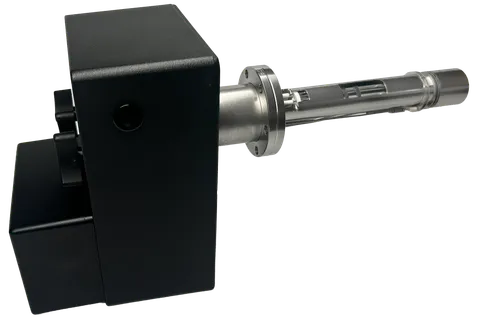
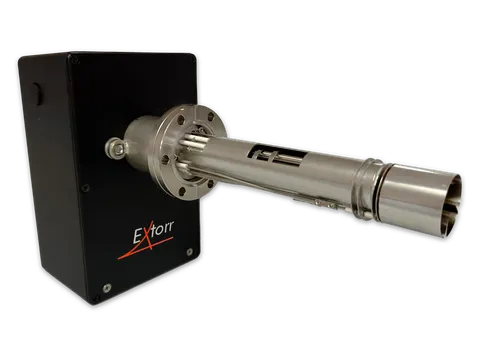
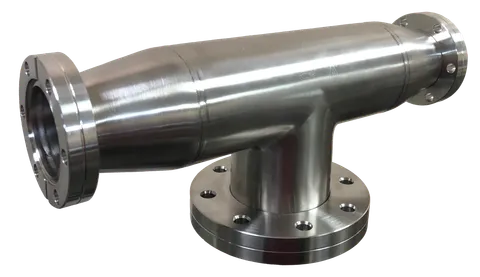
During active deposition cycles, chamber pressures are often higher than what an RGA can safely tolerate. In these cases, the RGA is typically installed in a separately pumped manifold using a turbo pump along with flow restrictors such as capillaries or small orifices. The process gas is leaked into this reduced-pressure region, allowing the RGA to safely analyze gas composition, even when the main chamber is operating at a higher pressure. Extorr supplies the probe manifolds, capillary tubing and high conductance valves used to build these sampling arrangements.
An electron multiplier further improves sensitivity and acquisition speed. Since RGAs must be protected from material deposition on their internal parts, care must be taken to ensure that the probe is not installed in the direct line-of-sight of the target.
A sampling manifold is also only as good as its worst day. If a turbo trips or a valve is opened in the wrong order, the probe sees process pressure directly and the filament is the first thing to go. The Pirani gauge built into the base of the Extorr probe reads through that range and shuts the filament down before it burns, which is worth having on a manifold that gets valved in and out around a running process.
Talk to us about your process
An RGA is therefore used to detect leaks, verify system cleanliness prior to deposition, and provide information on reaction byproducts. Whether you are running thin film research, managing a vacuum deposition process, or developing semiconductor equipment, contact us to learn how an Extorr RGA can help with your specific application.