Thermal vacuum chamber testing
Residual gas analyzers are a valuable tool in space hardware testing, particularly in Thermal Vacuum Chambers (TVACs). In these environments, they are commonly used to detect and analyze outgassing components and background gases as chamber temperatures change. Identifying the species released during thermal cycling supports material compatibility studies, leak detection, and overall performance assessment.
RGA data provides operations personnel with critical insight into the effectiveness and completeness of bakeout procedures, early identification of vacuum system leaks, and characterization of volatile species outgassing from a test article. This is important in understanding the long term behavior and reliability of spacecraft components in flight-like conditions.
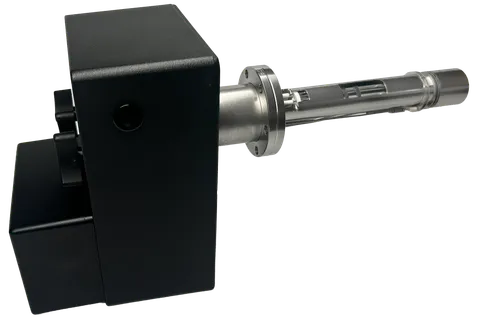
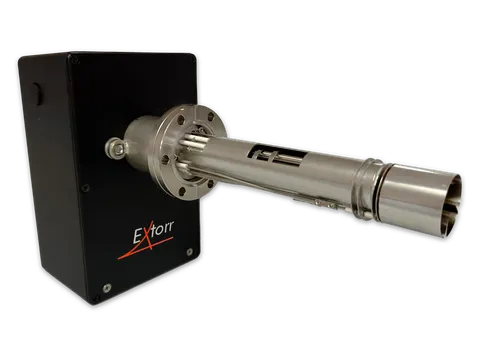
A bakeout is easier to judge when total pressure and the individual masses come off the same instrument on the same timebase. The Extorr probe has a Pirani gauge and a Bayard-Alpert type ion gauge built in, so the total pressure record sits alongside the water and hydrocarbon traces without a second gauge controller in the chamber or a second set of logs to line up afterwards.
Electric propulsion and electrospray thrusters
RGAs are also a critical tool in the development and qualification of electric propulsion systems. They are well-suited to the electrospray test environment due to their non-invasive operation, high sensitivity, and compatibility with high-vacuum environments. Prior to thruster operation, they are used to confirm chamber cleanliness and establish baseline gas composition. Ionic-liquid propellants used in electrospray thrusters are highly sensitive to humidity and oxidation, making monitoring of H2O and O2 partial pressures particularly important before ignition.
During propulsion testing, an RGA can also be used to verify the purity of purge gases (e.g. argon, nitrogen) and to monitor propellant-related species, including xenon where applicable. Once firing begins, RGAs can be used to track the relative densities of the emitted species, fragmentation products, and byproducts of electrochemical reactions within the system. Trending this data over time provides valuable insight into thruster behavior, propellant stability, and system interactions during extended operation.
Talk to us about your test campaign
From confirming chamber cleanliness and tracking outgassing, to monitoring propellant related species during firing, an RGA helps engineers understand how the system behaves under realistic vacuum conditions. Contact us to learn how an Extorr RGA can support your specific application.