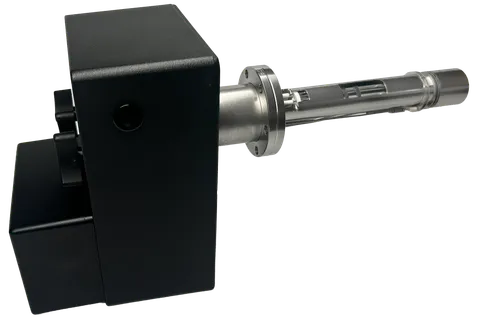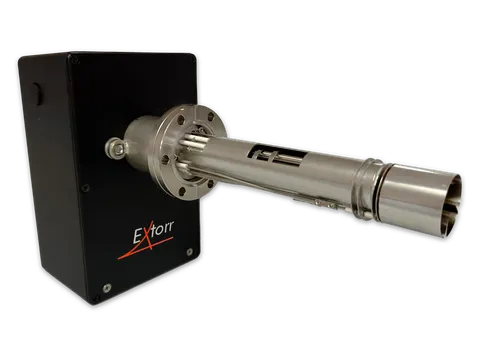
Ultra high vacuum is a specialized regime of vacuum science, characterized by pressures in the range of 10-9 Torr or below. Getting there isn't easy, and it requires extreme attention to system cleanliness, material selection and leak tightness. Residual gas analyzers play an important role in diagnosing both leaks and contamination sources in UHV systems.
Gross leaks, above where an RGA normally operates
Unlike other commercial RGAs, an Extorr RGA can be used to identify gross leaks by using a variety of different leak gases, because of the built-in Pirani gauge. When a gross leak is present, exposure to the leak gas produces a sharp rise in system pressure, detected immediately by the Pirani gauge, allowing leak identification under rough-vacuum conditions where traditional RGAs are ineffective.
The other half of that is a genuine Bayard-Alpert type ion gauge in the ionizer, rather than a total pressure reading inferred from the quadrupole's own ions. Most schemes for the latter have a high x-ray limit, mass discrimination, or a sensitivity that drifts with the age of the ionizer — all of which matter when the question is whether a leak actually got smaller between one measurement and the next. Between the two gauges, the same probe follows a system from atmosphere to UHV with a total pressure number you can trust the whole way down.
Air leaks and helium spraying
Once the pressure drops below 10-4 Torr, the quadrupole will begin operation and a mass spectrum will be displayed. At this point, the RGA can be used to detect a leak by monitoring atmospheric gases like nitrogen and oxygen. A persistent 4:1 ratio of peak heights at 28 and 32 amu is a strong indicator of an air leak.
The RGA can then be used to look for the source of the leak with an audio output corresponding to its intensity. Unlike traditional leak detectors, a variety of leak detection gases can be used, but helium is usually the most common. After setting up the mass table correctly in the RGA software (refer to the manual for details), a small amount of helium is sprayed around suspected flanges and feedthroughs. Because helium is a very small molecule, it readily enters the leak, causing its partial pressure, and the audio intensity, to increase. As helium flows into the leak, it displaces air, and the partial pressures of mass 28 and 32 decrease. When the spray is removed, air slowly replaces the helium and the nitrogen and oxygen signals rise again.
Virtual leaks
RGAs are even more helpful for identifying internal leaks, often referred to as virtual leaks. These come from trapped volumes of gas within the vacuum system that slowly release over time. Common sources include trapped air in weld joints or threaded holes, porous materials, and improperly vented components. These issues can significantly increase pump-down times and prevent a system from reaching its target vacuum level. Traditional leak detectors do not detect these types of leaks.
The sensitivity of an Extorr RGA is comparable to that of a standard leak detector, and when equipped with an electron multiplier, it can exceed the sensitivity of even the best conventional leak checkers.
Bakeout and water vapor
One of the biggest hurdles in reaching UHV conditions is moisture. Water loves to stick to chamber walls, so a proper bakeout is necessary. RGAs are used to verify the effectiveness of the bakeout and determine when the process is complete. The Extorr RGA can monitor the total pressure of the vacuum system and the partial pressure of the residual gases during bakeout. As the chamber is first heated, the total pressure and the water signal (m/z 18) will initially increase as molecules desorb from internal surfaces. These signals will reach a peak value and then slowly decrease over time. Eventually, the pressure levels off, indicating that most of the moisture has been removed and the heaters can be turned off. As the chamber cools, pressure drops further, leaving very little residual water in the system. This bakeout process is often repeated whenever the chamber is vented to atmosphere to quickly restore UHV conditions.
Surface analysis systems
Several customers also use the Extorr RGA in the vacuum chambers of surface science techniques like XPS, LEED, Auger, SEM and STM systems. These techniques require both clean samples and ultra-clean UHV conditions to minimize contamination, particularly from hydrocarbons. The RGA can be used to identify leaks in SEM systems and to monitor residual gas species before and after cleaning steps. This allows users to determine the endpoint of cleaning and achieve the atomically clean surfaces needed for high-resolution, stable imaging.
Talk to us about your system
Contact us to discuss your specific application, and learn how an Extorr RGA can help with your leak detection and vacuum monitoring needs.