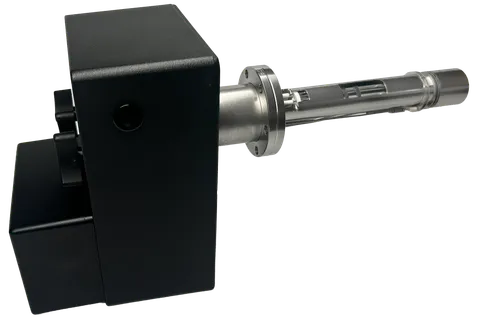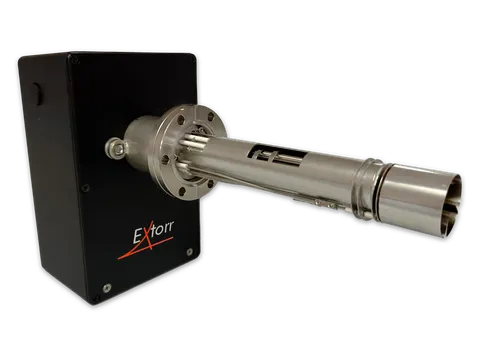
In surface-science and catalysis research, RGAs are an integral tool for identifying and tracking gas-phase species evolved from solid surfaces. Researchers studying adsorption, surface reactions and thermal decomposition on metals, metal oxides and other engineered surfaces have used Extorr RGAs to monitor gas-phase species during deposition and subsequent heating cycles. Continuous observation of the gas composition allows surface processes to be directly linked to the molecules leaving the surface.
Temperature-programmed desorption
This becomes especially important in temperature-programmed desorption (TPD) experiments. The Extorr RGA can be used in Mass Sweep (pressure versus time) mode to monitor various mass ranges during a desorption cycle. By sequentially monitoring several masses, decomposition mechanisms and reaction products can be deduced. The time-stamped mass data can be directly correlated with temperature data from the reactor controller, yielding a complete TPD profile.
Chamber cleanliness and gas purity
In addition to this, RGAs are also used for residual gas analysis to verify chamber cleanliness and background composition, as well as for leak detection and gas purity verification of UHV systems.
Talk to us about your experiment
An RGA provides a window into the chemistry happening at the surface. TPD data yields important kinetic and thermodynamic information pertaining to solid-gas interactions, forming the foundation of fundamental heterogeneous catalysis research. Contact us to discuss your specific application, and to learn how an Extorr RGA can support your catalysis research.